
 By
By 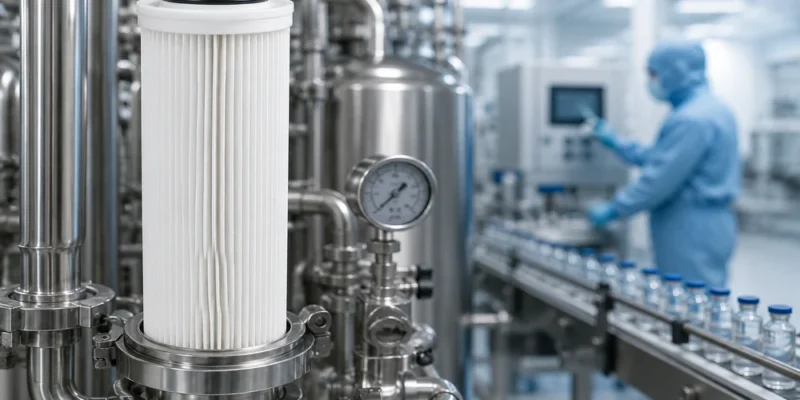
Across global biologics manufacturing – from Roche, Genentech, and Lonza CDMO operations to Biocon, Bharat Biotech, Serum Institute, Dr Reddy’s Biologics, Wockhardt Biotech, and the emerging GCC and African biomanufacturing programmed – the bioreactor is the single most consequential piece of equipment on site. A 10,000-litre mammalian cell culture campaign producing monoclonal antibodies represents USD 500,000 to 10 million in product value across 14 to 21 days. A vaccine fermenter at commercial scale carries similar exposure. The integrity of every one of those campaigns depends on two filtration points that almost nobody outside the operations team thinks about: the inlet air sterile
filter on the sparger line, and – even more critically – the exhaust vent filter on the bioreactor off-gas line.
The exhaust vent filter is the most demanding filtration duty in bioprocess. It must handle saturated humid exhaust air at 100% relative humidity, foam aerosols generated during sparger aeration, viable organism aerosols at concentrations of 10⁴ to 10⁸ CFU/mL of culture broth, and – in anaerobic fermentation – H₂S-laden biogas at 1,000-5,000 ppm. It must maintain integrity continuously for 7 to 21 days. And in the 2022 revision of EU GMP Annex 1, it must do so with documented integrity testing before and after every campaign, with full validation records that survive USFDA, EMA, and WHO PQ inspection. This article explains why a properly engineered PTFE Hydrophobic Cartridge Filter Housing has become the universal global standard for bioreactor sterile vent service, and why getting this single component wrong is one of the highest-consequence failures in modern biopharmaceutical manufacturing.
The Hidden Stakes of Bioreactor Vent Filter Failure
Three numbers explain why bioreactor vent filtration deserves the same engineering attention as the bioreactor itself.
Stake one: campaign-terminating contamination. A single vent filter integrity failure during a mammalian cell culture campaign can introduce external contamination through the off-gas line into the bioreactor headspace, or release live GMO organisms into the manufacturing environment. Either failure terminates the campaign irreversibly – a documented loss of USD 500,000 to 10 million per batch on commercial mAb production, and significantly more for high-value oncology biologics or advanced cell and gene therapies. The vent filter is among the lowest-cost components in the bioreactor system; the consequence of failure is among the highest.
Stake two: foam events and filter wet-out. Mammalian cell culture and microbial fermentation routinely experience foam events during sparger aeration. Foam carries culture broth aerosols directly to the vent filter face. A hydrophilic filter – cellulose, PVDF, or PES – wets out under foam exposure within minutes, creating a liquid-filled filter with zero airflow. The downstream consequence is bioreactor back-pressure cascade: the aeration control system trips, oxygen transfer to the culture stops, cell density collapses, and the campaign ends. The engineered answer is PTFE hydrophobic membrane media that physically cannot wet out – the only acceptable choice for sterile vent service.
Stake three: regulatory exposure under Annex 1 (2022). The 2022 revision of EU GMP Annex 1 has tightened sterile manufacturing vent filter documentation requirements substantially. Pre-use and post-use integrity testing of sterilising-grade vent filters is now examined directly during EMA, WHO PQ, and reciprocal USFDA inspections. Documentation gaps on bioreactor vent integrity testing are now appearing as the most common Category II findings on inspections of Indian, Latin American, and Southeast Asian biologics
manufacturers exporting to regulated markets. Loss of WHO PQ listing or EU MA can suspend export licences for entire product franchises.
Why Generic Vent Filtration Fails on Bioreactor Service
Bioreactor sterile vent service combines four constraints that defeat any conventional industrial filtration:
• Hydrophilic membrane wet-out under foam exposure. Generic cellulose or PVDF vent filters wet out within minutes of foam contact. Once wetted, gas flow drops to zero – a catastrophic failure mode for a continuously-running bioreactor. The engineered answer is PTFE hydrophobic membrane media with documented foam resistance and contact-angle data confirming non-wetting behaviour across the full bioreactor operating envelope.
• Inability to handle saturated humid exhaust. Bioreactor exhaust air leaves the headspace at 100% relative humidity and 30-40°C. As it cools in the vent line, condensate forms on the filter face. Without heated housing or hydrophobic membrane, condensate accumulates and blocks gas flow. The engineered answer is a heated SS 316L housing maintaining filter media above dew point, combined with hydrophobic PTFE membrane that physically rejects accumulated condensate.
• Sub-pharmaceutical materials in housing construction. Generic vent filter housings without ASME BPE-compliant geometry, pharmaceutical-grade surface finish, or full extractables documentation cannot be qualified for biotech service. The engineered answer is SS 316L electropolished housings with sanitary tri-clamp connections, autoclavable to 134°C, with complete documentation pack for Annex 1 validation.
• Sour service in anaerobic fermentation. Anaerobic fermentation processes (vitamin B12, certain amino acids, fermentation-derived APIs) generate biogas with H₂S at 1,000-5,000 ppm. Standard SS 316L vent filter housings corrode under H₂S exposure, with structural failure within months. The engineered answer is Hastelloy C-276 housing construction for anaerobic service, validated against documented H₂S corrosion data.
Each of these failures independently terminates bioreactor campaigns. Their combined effect is what produces the recurring contamination events and regulatory findings cited in biologics inspection reports globally.
The FCPL Solution: PTFE Hydrophobic Cartridge Filter Housing for Bioreactor Sterile Vent
Filter Concept’s engineered solution for bioreactor and fermenter sterile vent service is a PTFE Hydrophobic Cartridge Filter Housing installed on the bioreactor exhaust line, immediately
upstream of the off-gas treatment system or atmospheric vent point. Every design element is matched to biopharmaceutical regulatory and operational reality.
0.2 micron PTFE hydrophobic gas-phase sterilising membrane. PTFE hydrophobic membrane media physically rejects culture broth aerosols, condensate, and foam – preserving gas flow continuity through extended campaign durations. Bacterial retention efficiency of ≥1×10⁷ CFU/cm² per ASTM F838 for gas-phase service. Each lot ships with integrity test certification (bubble point or water intrusion test per USFDA guidance) and full extractables study documentation.
Heated SS 316L housing with ASME BPE geometry. Electropolished SS 316L housing with Ra ≤ 0.4 µm product-contact surfaces. Heated jacket option maintains filter media above dew point throughout the bioreactor temperature cycle (−50°C during freezing through +37°C culture to +143°C SIP). Fully drainable design with sanitary tri-clamp connections matched to bioprocess pipework. SIP-compatible to 134°C with documented 25-cycle validation.
Duplex configuration for extended campaigns. For bioreactors larger than 2,000 litres or campaigns extending beyond 14 days, twin-filter configuration in parallel allows online switchover during the campaign without aeration interruption. Critical for biosimilar producers running 21-day mAb campaigns where mid-campaign filter change is operationally impossible.
Anaerobic fermentation variant. For anaerobic fermentation service (vitamin B12, biotech APIs, certain bacterial expression systems), FCPL supplies the housing in Hastelloy C-276 with documented H₂S service certification. PTFE membrane is intrinsically inert to H₂S, CO₂, and biological metabolites – the only material chemistry that survives long-term anaerobic vent service.
Annex 1 documentation pack. Each housing ships with documentation designed for direct insertion into Annex 1 validation files: bacterial retention test certification (ASTM F838), water intrusion test method validation, EN 10204-3.1 material certification, surface finish certificate, USP <88> Class VI biocompatibility, endotoxin certification, and full DQ/IQ/OQ/PQ template documentation.
FC-PDS™ specification methodology. Cartridge format (single or twin), housing material (SS 316L or Hastelloy), heated jacket selection, and changeout protocol are specified from your actual bioreactor scale, organism class (mammalian, microbial, anaerobic, GMO), campaign duration, and regulatory destination markets. Site-specific engineering produces the campaign-spanning integrity that high-value biologics manufacturing requires.
The Bottom Line for Biotech Operations Heads, QA Leadership, and Validation Teams
Bioreactor vent filtration is the rare engineering decision where the regulatory case, the product value case, the biosafety case, and the operational case all align in the same direction. The cost of getting it wrong is not a maintenance line item – it is campaign-terminating contamination measured in millions of dollars per batch, GMO release biosafety consequence, Annex 1 audit findings cascading through manufacturing licences, and – in the worst case – product franchise suspension. The cost of getting it right is a fraction of one avoided campaign loss.
Filter Concept has been engineering biotech and biopharmaceutical filtration solutions for over twenty-three years, with installations across mammalian cell culture, microbial fermentation, vaccine manufacturing, biosimilar production, and CDMO operations in 90+ countries. Customers include Biocon Biologics, Dr Reddy’s, Wockhardt Biotech, Bharat Biotech, Serum Institute, Intas Biopharmaceuticals (India), Julphar UAE biotech, SPIMACO biologics Saudi
Arabia, and emerging biomanufacturing capacity across Latin America and Southeast Asia. The PTFE Hydrophobic Cartridge Filter Housing for bioreactor sterile vent service is one of our most engineered, most validated installations – because biotech regulatory requirements are now globally harmonised, but the discipline of engineering hydrophobic membrane housings with heated jackets, anaerobic-service metallurgy options, and Annex 1 documentation packs is rare in the global filtration market.
If your last USFDA, EMA, WHO PQ, or CDSCO inspection raised any flags on bioreactor vent integrity testing, if your campaign foam events have caused vent filter wet-out, or if your anaerobic fermentation operation has experienced vent housing corrosion – your bioreactor sterile vent filtration is the first place to look. We are happy to review your bioreactor specification and offer a sized FC-PDS™ specification at no obligation, anywhere in the world.





Comments